Have you ever written a sentence like Our you coming today? or Are house is beautiful? If so, you’re not alone.
The words are and our are among the most commonly confused words in English because they sound almost the same in many accents. However, they have completely different meanings and grammatical roles.
Understanding the difference between are vs our is essential for clear communication.
Whether you’re writing an email, completing school assignments, preparing business documents, or chatting with friends, choosing the correct word makes your writing more professional and easier to understand.
In this guide, you’ll learn what are and our mean, how they differ, when to use each one, common mistakes to avoid, and practical examples you can apply immediately.
Quick Answer
Are is a verb—a form of the verb to be. It is used to describe a state, identity, or condition.
Our is a possessive determiner. It shows that something belongs to us.
Examples:
- We are ready.
- This is our classroom.
Although they sound similar, are and our are not interchangeable.
At a Glance: Are vs Our
| Feature | Are | Our |
|---|---|---|
| Part of Speech | Verb | Possessive determiner |
| Meaning | A form of to be | Belonging to us |
| Pronunciation | /ɑːr/ or /ɑr/ | /aʊər/ or /ɑːr/ (varies by accent) |
| Function | Connects the subject with information | Shows ownership |
| Used Before Nouns | No | Yes |
| Indicates Possession | No | Yes |
| Indicates State or Condition | Yes | No |
| Common Mistake | Using it instead of our | Using it instead of are |
| Formal Writing | Yes | Yes |
| Everyday Conversation | Yes | Yes |
| Academic Writing | Yes | Yes |
| Business Writing | Yes | Yes |
| US English | Same meaning | Same meaning |
| UK English | Same meaning | Same meaning |
| Easy Memory Tip | Think of to be | Think of belongs to us |
Why Do People Confuse “Are” and “Our”?
Many English learners—and even native speakers—mix up are and our because they are homophones in many accents. Homophones are words that sound alike but have different meanings and spellings.
Other reasons include:
- Fast pronunciation in everyday speech.
- Typing quickly on phones or computers.
- Autocorrect mistakes.
- Limited understanding of English grammar.
- Learning English primarily through listening rather than reading.
The good news is that once you understand each word’s grammatical role, the confusion becomes much easier to avoid.
Understanding Are
What Does “Are” Mean?
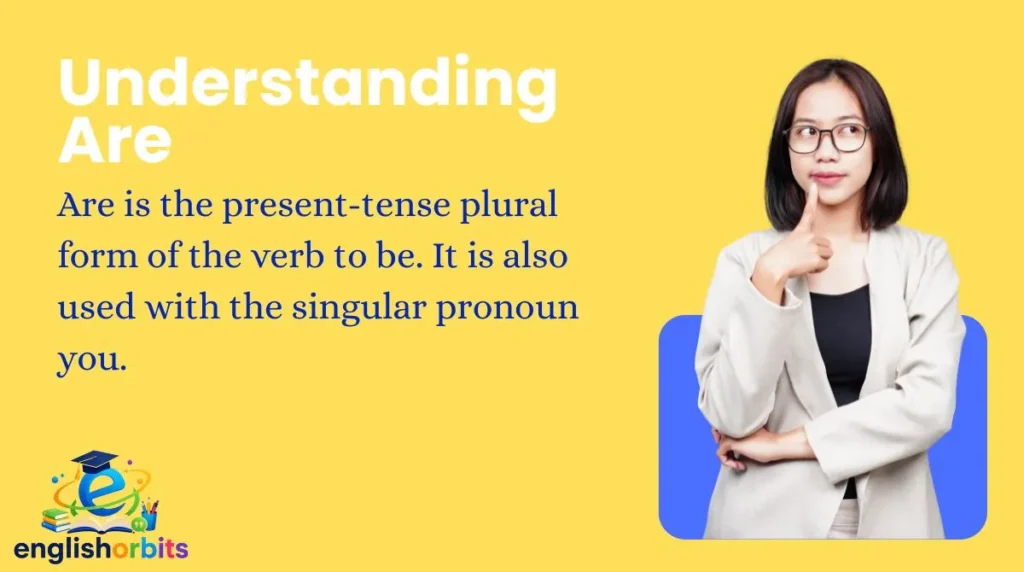
Are is the present-tense plural form of the verb to be. It is also used with the singular pronoun you.
It helps describe:
- Identity
- Condition
- Location
- Existence
- Characteristics
- Ongoing actions (with another verb)
Examples:
- We are happy.
- They are doctors.
- You are welcome.
Without are, many English sentences would be grammatically incomplete.
Part of Speech
Are is a verb.
More specifically, it is one of the present-tense forms of the irregular verb to be.
Present forms include:
| Subject | Verb |
|---|---|
| I | am |
| You | are |
| We | are |
| They | are |
| He | is |
| She | is |
| It | is |
Pronunciation
In American English:
are → /ɑr/
In British English:
are → /ɑː/
In casual speech, it may sound shorter, especially in contractions such as:
- You’re
- They’re
- We’re
Origin of “Are”
The word are has a long linguistic history. It developed from Old English and other Germanic languages before becoming the modern English verb we use today.
Because to be is one of the oldest and most frequently used verbs in English, are appears in millions of spoken and written sentences every day.
When Should You Use “Are”?
Use are whenever you need a present-tense form of to be with:
- You
- We
- They
- Plural nouns
Examples:
- The students are studying.
- We are excited.
- You are correct.
- My friends are waiting outside.
- These books are expensive.
“Are” in Questions
One of the most common uses of are is to begin questions.
Examples:
- Are you hungry?
- Are they coming?
- Are we late?
- Are those your keys?
- Are the children asleep?
Notice that are comes before the subject in these questions.
“Are” in Negative Sentences
To make a negative sentence, add not after are.
Examples:
- We are not ready.
- They are not here.
- You are not alone.
Common contractions include:
- aren’t
- you’re not
- we’re not
- they’re not
“Are” in Continuous Tenses
Are also helps form the present continuous tense.
Structure:
Subject + are + verb-ing
Examples:
- We are learning English.
- They are working today.
- You are reading this guide.
- The children are playing outside.
- The engineers are testing the software.
“Are” in Professional Writing
Business communication often relies on are.
Examples:
- We are pleased to announce the launch.
- You are invited to the meeting.
- Our products are available worldwide.
- Employees are expected to follow company policies.
- The reports are due on Friday.
Using are correctly makes professional writing sound polished and grammatically accurate.
“Are” in Academic Writing
Academic writing frequently uses are to explain facts, research, and observations.
Examples:
- The findings are significant.
- These results are consistent with previous studies.
- The participants are divided into two groups.
- The data are presented in Table 1.
- These theories are widely accepted.
“Are” in Everyday Conversation
You’ll hear are constantly in daily life.
Examples:
- How are you?
- We are almost there.
- They are my neighbors.
- You are amazing.
- The stores are open now.
- These cookies are delicious.
- We are watching a movie tonight.
- The kids are asleep.
- You are always welcome here.
- They are on vacation this week.
Common Mistakes with “Are”
Many learners accidentally replace are with our, especially when writing quickly.
Incorrect:
- Our going to the park.
Correct:
- We’re going to the park.
- We are going to the park.
Incorrect:
- Our you ready?
Correct:
- Are you ready?
Incorrect:
- Our they teachers?
Correct:
- Are they teachers?
A simple check can prevent this mistake: if the sentence needs a verb, use are, not our.
Quick Tips for Using “Are”
✅ Use are after you, we, and they.
✅ Use are with plural nouns.
✅ Use are to describe a state or condition.
✅ Use are to form questions.
✅ Use are with -ing verbs in continuous tenses.
❌ Never use are to show ownership.
Quick Summary: Are
Are is a verb that expresses being, identity, condition, or ongoing actions. If your sentence needs a form of to be, are is often the correct choice with you, we, they, and plural nouns.
Understanding Our
What Does “Our” Mean?
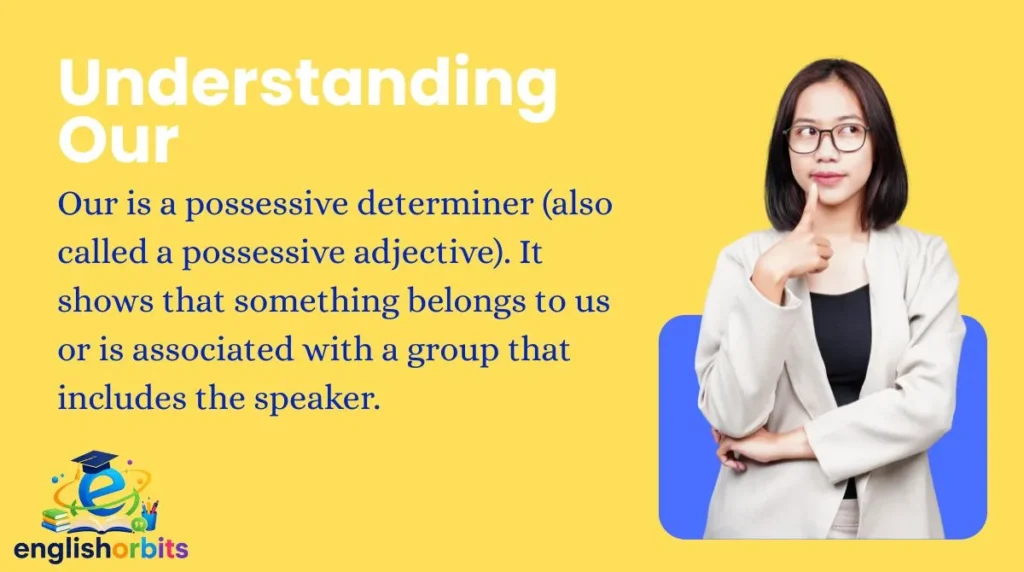
Our is a possessive determiner (also called a possessive adjective). It shows that something belongs to us or is associated with a group that includes the speaker.
Unlike are, our is not a verb. It always comes before a noun to show ownership or relationship.
Examples:
- This is our house.
- Our teacher is very kind.
- We love our community.
Part of Speech
Our is a possessive determiner.
It modifies a noun by telling readers who owns or is connected to something.
| Pronoun | Possessive Determiner |
|---|---|
| I | my |
| You | your |
| He | his |
| She | her |
| It | its |
| We | our |
| They | their |
Pronunciation
In many English accents, our is pronounced:
- /aʊər/
- /ɑːr/
Because some speakers pronounce our very similarly to are, these words are often confused in writing, even though their meanings are completely different.
Origin of “Our”
The word our comes from Old English and has been used for centuries to express shared ownership or belonging.
Today, it remains one of the most common possessive words in English.
When Should You Use “Our”?
Use our whenever something belongs to us.
Examples:
- Our family loves hiking.
- Our school starts at eight.
- Our company is growing.
- Our neighbors are friendly.
- Our team won the championship.
Notice that our is always followed by a noun.
“Our” in Professional Writing
Business communication frequently uses our to refer to organizations, teams, products, or services.
Examples:
- Our mission is customer satisfaction.
- Our employees receive ongoing training.
- Our website has been updated.
- Our support team is available 24/7.
- Thank you for choosing our services.
“Our” in Academic Writing
Academic writing also uses our, especially in collaborative research or institutional contexts.
Examples:
- Our findings support the hypothesis.
- Our research focused on language development.
- Our analysis revealed several trends.
- Our study included 500 participants.
- Our conclusion is based on the collected evidence.
“Our” in Everyday Conversation
You’ll hear our naturally in daily conversations.
Examples:
- Our dog loves playing outside.
- Our car needs fuel.
- Our vacation starts tomorrow.
- Our friends are visiting tonight.
- Our favorite restaurant reopened.
Common Mistakes with “Our”
Because our sounds like are in some accents, writers sometimes use it where a verb is needed.
Incorrect:
- Our happy today.
Correct:
- We are happy today.
Incorrect:
- Our you coming?
Correct:
- Are you coming?
Incorrect:
- The students our excited.
Correct:
- The students are excited.
A useful rule is this:
If the next word is a noun, our may be correct. If the sentence needs a verb, choose are.
Quick Tips for Using “Our”
✅ Use our to show ownership.
✅ Place our before a noun.
✅ Use our when talking about something shared by “we.”
❌ Never use our as a verb.
❌ Never replace are with our simply because they sound alike.
Quick Summary: Our
Our shows that something belongs to us. It is a possessive determiner and must be followed by a noun.
Are vs Our: Key Differences
Although are and our may sound similar, they serve completely different purposes in English grammar.
- Are is a verb; our is a possessive determiner.
- Are describes a state, condition, or action; our shows ownership.
- Are can stand alone as the main verb; our cannot.
- Our must be followed by a noun.
- Are is used with you, we, they, and plural nouns.
- Our refers to something belonging to us.
- Both words are correct, but they are never interchangeable.
- Choosing the wrong one changes the grammar of the sentence.
Quick Rule:
If you can replace the word with “belonging to us,” use our. If you need a form of to be, use are.
Grammar Explanation
Understanding the grammar behind these words makes choosing the correct one much easier.
Are
- Part of speech: Verb
- Verb type: Present tense of to be
- Used with:
- You
- We
- They
- Plural nouns
- Forms questions and negative sentences.
- Helps create continuous tenses.
Our
- Part of speech: Possessive determiner
- Shows ownership or association.
- Always comes before a noun.
- Cannot function as a verb.
- Does not change with tense.
US vs UK English
There is no grammatical difference between American and British English when using are and our. Both varieties follow the same rules. The only noticeable difference may be pronunciation.
Style Guide Recommendations
Major style guides and dictionaries, including AP Style, The Chicago Manual of Style, Merriam-Webster, Oxford, Cambridge, and Collins, all treat are and our according to the same standard grammar rules.
Real-Life Examples
Everyday Conversation
- We are leaving now.
- Our bus arrives at noon.
- They are my cousins.
- Our garden looks beautiful.
School
- The students are preparing for exams.
- Our classroom has new computers.
- We are studying English grammar.
- Our teacher explained the lesson clearly.
Business
- Our company values innovation.
- The reports are ready.
- Our clients appreciate quick responses.
- The meetings are scheduled for Monday.
- We are pleased to confirm your registration.
- Our office will be closed tomorrow.
- You are invited to attend the seminar.
Social Media
- We are live now!
- Our latest video is online.
Text Messages
- Are you home yet?
- Our dinner is almost ready.
Academic Writing
- Our research supports the theory.
- The results are statistically significant.
Professional Writing
- Our proposal meets all project requirements.
- The recommendations are based on current data.
Daily Speaking
- We are excited about the trip.
- Our neighbors just moved in.
Common Mistakes
| Incorrect Sentence | Why It’s Wrong | Correct Sentence |
|---|---|---|
| Our you ready? | Our cannot be used as a verb. | Are you ready? |
| Are house is big. | Are does not show possession. | Our house is big. |
| Our happy today. | A verb is missing. | We are happy today. |
| The books our new. | Needs a verb. | The books are new. |
| Are family lives here. | Needs a possessive determiner. | Our family lives here. |
| Our they finished? | Question requires a verb. | Are they finished? |
Memory Tricks
Trick 1: Think of Ownership
If something belongs to us, use our.
Our home
Our team
Our ideas
Trick 2: Think of “To Be”
If the sentence needs a form of to be, use are.
We are ready.
They are busy.
Trick 3: Look at the Next Word
If the next word is a noun, our is often correct.
- Our school
- Our family
- Our project
If the next word is an adjective or another verb form, you probably need are.
- Are happy
- Are working
- Are ready
Trick 4: Substitute the Meaning
Ask yourself:
Can I replace the word with “belonging to us”?
- ✔ Our car = the car belonging to us.
- ✘ Are car = doesn’t make sense.
Frequently Asked Questions
Is are or our correct?
Both are correct, but they are used in different situations. Are is a verb, while our shows possession.
Why do people confuse are and our?
They are pronounced similarly in many accents, making them easy to mix up when writing.
Can our replace are?
No. Our cannot function as a verb.
Is our a pronoun?
No. Our is a possessive determiner because it comes before a noun.
Is are always a verb?
Yes. Are is a present-tense form of the verb to be.
How can I remember the difference?
Remember this simple rule:
- Are = to be
- Our = belongs to us
Are are and our interchangeable?
No. Although they may sound alike, they have different meanings and grammatical functions.
Do American and British English use these words differently?
No. Both varieties of English follow the same grammar rules for are and our.
Final Verdict
The difference between are vs our is simple once you understand their roles in a sentence.
- Use are when you need a form of the verb to be. It describes a state, condition, identity, or helps form questions and continuous tenses.
- Use our when you want to show ownership or belonging. It always comes before a noun and tells readers that something belongs to us.
While these words often sound alike, they are not interchangeable. A quick grammar check can help: if the sentence needs a verb, choose are; if it needs to show possession, choose our. Mastering this distinction will improve your grammar, make your writing more accurate, and help you communicate with confidence in academic, professional, and everyday English.

Ghulam Qamar is an English grammar writer and language enthusiast dedicated to simplifying complex grammar concepts. He creates clear, practical, and beginner-friendly content that helps learners improve their English writing, speaking, and communication skills.