If you’ve ever wondered whether you should write competence or competency, you’re not alone.
These two words look similar, share the same root, and are often used interchangeably. Yet, depending on the context, one may sound more natural or be the preferred choice.
The confusion is especially common in workplaces, educational settings, job descriptions, performance reviews, and professional certifications.
Some organizations emphasize core competencies, while others assess professional competence. Understanding why both terms exist—and when to choose one over the other—can make your writing clearer and more precise.
In this comprehensive guide, you’ll discover the meaning of competence vs competency, their subtle differences, where they overlap, how professionals use them, and which term is best for different situations.
By the end, you’ll be able to use both words with confidence in business writing, academic papers, resumes, interviews, and everyday English.
Quick Answer
Both “competence” and “competency” are correct, but they are not always used in exactly the same way.
- Competence usually refers to the overall ability to perform a task effectively.
- Competency often refers to a specific skill, behavior, or measurable capability needed for success.
- In everyday English, the words are frequently interchangeable.
- In business, HR, education, and professional development, competency often has a more technical meaning.
Competence vs Competency Comparison Table
| Feature | Competence | Competency |
|---|---|---|
| Meaning | Overall ability or capability | A specific skill, behavior, or measurable ability |
| Part of Speech | Noun | Noun |
| Pronunciation | KOM-pi-tuhns | KOM-pi-tuhn-see |
| Grammar | Countable and uncountable in some contexts | Usually countable |
| Common Usage | General English, education, legal writing | HR, business, leadership, training |
| Focus | Overall effectiveness | Individual abilities and skills |
| Professional Context | Demonstrating capability | Meeting defined performance standards |
| Academic Context | Frequently used | Common in educational frameworks |
| Resume Usage | Highlights overall ability | Highlights individual skills |
| Performance Reviews | Less specific | More structured and measurable |
| Common Phrase | Professional competence | Leadership competency |
| Tone | Broader and more general | More technical and specific |
| American English | Widely used | Widely used |
| British English | Very common | Also common, especially in HR |
| Can They Replace Each Other? | Sometimes | Sometimes, depending on context |
Competence vs Competency: Understanding the Core Difference
At first glance, these words seem identical because both come from the adjective competent, meaning having the necessary ability or knowledge to do something successfully. However, modern English has gradually assigned each word a slightly different role.
Think of it this way:
- Competence describes your overall capability.
- Competency describes the individual building blocks that create that capability.
Imagine a successful project manager. Their competence is the ability to manage projects effectively. Their competencies might include communication, leadership, budgeting, negotiation, planning, and problem-solving. Together, these competencies contribute to overall competence.
This distinction is especially useful in professional environments where organizations need to define, measure, and develop specific employee skills.
What Does “Competence” Mean?
Definition
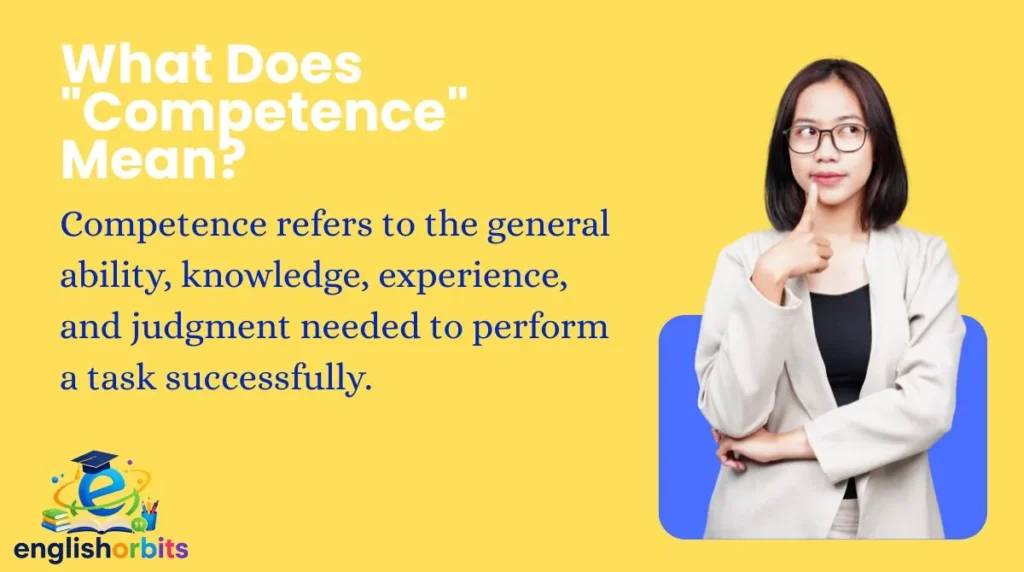
Competence refers to the general ability, knowledge, experience, and judgment needed to perform a task successfully.
Rather than focusing on one specific skill, it reflects someone’s overall effectiveness in a particular role or activity.
Pronunciation
Competence
/ˈkɒm.pɪ.təns/ (British English)
/ˈkɑːm.pə.təns/ (American English)
Origin of the Word
The word competence comes from the Latin competentia, meaning agreement, fitness, or suitability. Over time, English adopted it to describe a person’s ability to perform adequately or successfully.
Historically, competence appeared in English centuries before competency, making it the older and more traditional term.
What Does Competence Express?
Competence usually describes:
- Overall ability
- Adequate knowledge
- Professional capability
- Effective performance
- Sound judgment
- Reliability
- Qualification for a role
It answers the question:
“Can this person successfully perform the job or responsibility?”
When Should You Use “Competence”?
Use competence when discussing someone’s overall capability rather than individual skills.
It works especially well when talking about:
- Professional qualifications
- Legal standards
- Medical practice
- Education
- General performance
- Expertise
- Overall effectiveness
Common Situations Where “Competence” Is Used
Professional Writing
Employers often evaluate an employee’s competence before assigning greater responsibilities.
Legal Context
Courts may determine whether an individual has the mental competence to make legal decisions.
Education
Teachers assess a student’s competence in reading, mathematics, or scientific reasoning.
Healthcare
Doctors must demonstrate professional competence before treating patients independently.
Everyday Conversation
People often refer to someone’s competence when describing how well they perform a task.
Common Collocations with “Competence”
You’ll frequently see competence paired with words such as:
- Professional competence
- Clinical competence
- Technical competence
- Managerial competence
- Language competence
- Cultural competence
- Core competence
- Demonstrated competence
- Proven competence
- Professional competence standards
These combinations emphasize overall capability rather than isolated skills.
Examples of “Competence” in Sentences
Here are original examples showing how competence is naturally used:
- Her competence impressed everyone during the interview.
- The company values technical competence above experience alone.
- Professional competence is essential for medical practitioners.
- His competence grew after several years in management.
- The committee questioned the engineer’s competence before approving the project.
- She demonstrated remarkable competence under pressure.
- The organization expects a high level of competence from its leaders.
- Good communication improves professional competence.
- The lawyer’s competence earned the client’s trust.
- Years of experience strengthened his overall competence.
Competence in Academic Writing
Academic institutions often use competence when discussing:
- Language competence
- Reading competence
- Mathematical competence
- Scientific competence
- Professional competence
- Cognitive competence
For example:
Students should develop critical thinking competence throughout the course.
Here, the focus is on an overall ability developed over time rather than a checklist of individual skills.
Competence in Business Writing
Business documents often use competence when discussing an employee’s overall effectiveness.
Examples include:
- Assessing managerial competence
- Demonstrating professional competence
- Improving organizational competence
- Evaluating technical competence
- Building operational competence
In annual reports or executive summaries, competence often refers to an organization’s overall strength rather than individual employee skills.
Competence in Everyday English
Outside professional settings, competence remains the more natural choice when discussing someone’s general ability.
Examples include:
- She has the competence to manage the event.
- I trust his competence completely.
- Their competence became obvious after the first meeting.
- The team’s competence helped complete the project ahead of schedule.
Native speakers often prefer competence because it sounds broader and less technical than competency.
Common Mistakes with “Competence”
Incorrect: She has many competences in leadership.
Better: She has strong leadership competencies.
or
Better: She has excellent leadership competence.
The choice depends on whether you’re referring to a collection of measurable skills (competencies) or an overall ability (competence).
Expert Tip
Use competence when you want to emphasize a person’s overall ability, expertise, or effectiveness. If you’re not discussing a structured skills framework, competence is usually the more natural and widely accepted choice.
What Does “Competency” Mean?
Definition
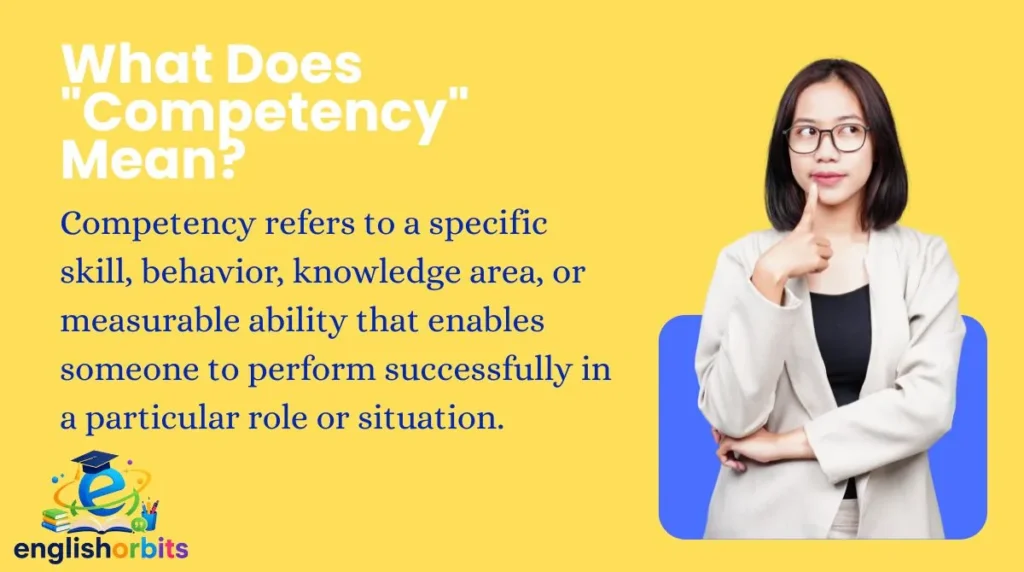
Competency refers to a specific skill, behavior, knowledge area, or measurable ability that enables someone to perform successfully in a particular role or situation.
Unlike competence, which describes overall capability, competency usually focuses on individual components that can be observed, assessed, and developed.
In modern workplaces, organizations often create competency frameworks that list the exact qualities employees should demonstrate to succeed.
Pronunciation
Competency
UK: /ˈkɒm.pɪ.tən.si/
US: /ˈkɑːm.pə.tən.si/
Origin of the Word
The word competency developed from the adjective competent, just like competence. Although both words have existed for many years, competency became especially popular during the late 20th century as businesses, governments, and educational institutions began creating structured systems for evaluating employee performance.
Today, it is widely used in:
- Human Resources (HR)
- Talent Management
- Leadership Development
- Employee Training
- Education
- Professional Certifications
- Organizational Development
What Does Competency Express?
A competency is typically:
- A measurable skill
- A specific behavior
- A learned capability
- A professional attribute
- An observable performance standard
It answers the question:
“Which specific abilities help this person perform successfully?”
When Should You Use “Competency”?
Use competency when discussing individual skills or abilities rather than someone’s overall capability.
It is the preferred choice in structured environments where skills are defined, assessed, or measured.
Common contexts include:
- Job descriptions
- Recruitment
- Performance evaluations
- Leadership models
- Training programs
- Professional certifications
- Learning and development plans
Common Situations Where “Competency” Is Used
Human Resources
Many organizations define the competencies required for each role before hiring new employees.
Leadership Development
Leadership programs often focus on developing strategic thinking, communication, and decision-making competencies.
Employee Performance Reviews
Managers assess employees against predefined competencies rather than relying on general impressions.
Education and Training
Training providers measure competency through practical assessments and demonstrations.
Professional Certifications
Certification bodies often require candidates to prove specific competencies before awarding credentials.
Common Collocations with “Competency”
You’ll frequently encounter competency in phrases such as:
- Leadership competency
- Core competency
- Technical competency
- Digital competency
- Professional competency
- Behavioral competency
- Communication competency
- Management competency
- Competency framework
- Competency model
- Competency assessment
- Competency development
- Competency-based learning
- Competency-based education
These expressions emphasize individual, measurable abilities.
Examples of “Competency” in Sentences
Here are original examples showing how competency is naturally used:
- Communication is an essential competency for project managers.
- The interview assessed leadership competencies.
- Every employee must demonstrate technical competency.
- Problem-solving is one of the company’s core competencies.
- The organization updated its competency framework this year.
- Digital competency has become increasingly valuable.
- Candidates are evaluated against key competencies.
- The course helps learners build professional competencies.
- Managers identified several competencies that required improvement.
- Creativity is considered a valuable workplace competency.
Competency in Business Writing
Modern businesses frequently use competency because it allows organizations to define performance expectations more precisely.
For example:
Instead of saying,
We need competent managers.
An HR document might say,
Managers should demonstrate competencies in leadership, communication, conflict resolution, and strategic planning.
This approach makes performance easier to evaluate and improve.
Competency in Academic Writing
Educational institutions increasingly use competency in discussions about learning outcomes.
Examples include:
- Competency-based education
- Competency-based assessment
- Professional competency standards
- Clinical competency evaluation
Rather than measuring only theoretical knowledge, competency-based learning evaluates whether students can apply their skills in real situations.
Competency in Everyday English
Although competency is perfectly correct, it sounds more technical than competence.
For casual conversations, native speakers often prefer:
✔ She has excellent competence in teaching.
Instead of:
✔ She has excellent competency in teaching.
However, if you’re discussing workplace skills or training, competency feels more natural.
Competence vs Competency: Key Differences
Although the two words are closely related, understanding their different roles helps you choose the right one in professional and everyday writing.
| Competence | Competency |
|---|---|
| Describes overall ability | Describes a specific skill or behavior |
| Broad concept | Narrow, measurable concept |
| General English | Technical and professional English |
| Focuses on capability | Focuses on individual performance criteria |
| Common in legal, academic, and everyday writing | Common in HR, training, and organizational development |
| Often viewed as the end result | Often viewed as the building blocks of success |
1. Scope
Competence is broad.
It reflects someone’s overall effectiveness.
Competency is specific.
It identifies one measurable ability that contributes to success.
2. Measurement
Competence is often judged as a whole.
Competencies can usually be measured individually.
For example:
A software engineer’s competence comes from competencies such as coding, debugging, teamwork, and problem-solving.
3. Workplace Usage
Most HR departments prefer competency because it fits structured evaluation systems.
Managers can rate employees on:
- Communication competency
- Leadership competency
- Technical competency
- Customer service competency
These individual competencies combine to demonstrate overall competence.
4. Everyday English
In daily conversation, competence is generally more common because it sounds simpler and more natural.
Examples:
✔ Her competence impressed everyone.
✔ His competence is unquestionable.
5. Academic and Professional Writing
Both words are accepted, but the preferred choice depends on context.
Use competence when discussing general capability.
Use competency when referring to defined learning outcomes, assessment criteria, or professional standards.
Are Competence and Competency Interchangeable?
Sometimes—but not always.
In casual conversation, many native speakers use the two words interchangeably without causing confusion.
For example:
- She has the competence to lead the team.
- She has the competency to lead the team.
Both are understandable.
However, in technical writing, the distinction becomes important.
A leadership handbook may define:
- 12 leadership competencies
- Overall leadership competence
Here, replacing one word with the other could change the intended meaning.
Which Word Is More Common?
In general English, competence is slightly more common.
In professional HR and organizational development, competency has become increasingly common because it supports structured evaluation systems.
You are therefore likely to see:
- Professional competence
- Clinical competence
- Language competence
alongside:
- Leadership competency
- Technical competency
- Communication competency
- Core competencies
Both forms are well established in modern English.
Grammar Explanation
Part of Speech
Both competence and competency are nouns.
Examples:
- Her competence impressed the committee.
- Leadership competency is essential.
Singular and Plural
Competence
- competence ✔
- competences ✔ (rare and usually technical)
Competency
- competency ✔
- competencies ✔ (very common)
Example:
The company identified five leadership competencies.
Countable vs. Uncountable
Competence
Often behaves as an uncountable noun when referring to overall ability.
Example:
✔ Professional competence takes years to develop.
It can occasionally be countable in specialized contexts.
Competency
Usually functions as a countable noun.
Example:
✔ The training program develops several competencies.
Adjective Form
Both words come from:
Competent
Examples:
- A competent engineer
- A competent teacher
- A competent lawyer
Related Word Family
| Word | Part of Speech |
|---|---|
| Competent | Adjective |
| Competence | Noun |
| Competency | Noun |
| Competently | Adverb |
| Competencies | Plural noun |
| Competences | Less common plural noun |
Professional Writing Recommendations
If you’re writing for:
Business Reports
Prefer competency when discussing measurable skills.
HR Documents
Use competency because it aligns with modern talent management terminology.
Academic Papers
Either word may be appropriate depending on your discipline, but use it consistently throughout the document.
Legal Writing
Competence is generally the preferred choice.
Examples:
- Mental competence
- Legal competence
- Professional competence
Everyday Communication
Choose competence unless you’re referring to a specific workplace skill framework.
Style Guide Insight
Major dictionaries recognize both competence and competency as correct. Rather than treating one as right and the other as wrong, modern usage favors competence for broad ability and competency for specific, measurable skills—especially in professional and educational contexts.
Real-Life Examples of Competence vs Competency
Seeing these words in context is the easiest way to understand the difference. The examples below cover conversations, emails, business writing, education, social media, and everyday situations.
Everyday Conversation
- Sarah’s competence as a chef is obvious after tasting her food.
- Time management is one of John’s strongest competencies.
- Her technical competence improved after years of practice.
- The training course focuses on building leadership competencies.
Workplace Examples
- The manager praised Emily’s professional competence during the annual review.
- Every employee must demonstrate the required competencies before promotion.
- His overall competence earned him the project lead role.
- Communication is a key competency for customer service representatives.
Business Emails
- We are confident in your professional competence and look forward to working with you.
- Please review the updated leadership competency framework before the workshop.
Academic Writing
- The research examined teachers’ digital competence in modern classrooms.
- Students are assessed against clearly defined learning competencies.
Job Interviews
- Your technical competence is impressive.
- Can you describe the leadership competencies you’ve developed?
Healthcare
- Doctors must maintain clinical competence throughout their careers.
- The certification measures clinical competencies using practical assessments.
Social Media
- Her design competence keeps attracting new clients.
- Creativity is a valuable competency in today’s workplace.
Daily Life
- Years of experience built his financial competence.
- Problem-solving is an essential competency for entrepreneurs.
Bonus Examples
- Professional competence comes from continuous learning.
- The company identified five core competencies for new managers.
- Cultural competence helps people work effectively with diverse teams.
- Analytical thinking is one of the most valuable leadership competencies.
Common Mistakes
Many learners use these words interchangeably in situations where one is more appropriate. Here are some common mistakes and how to fix them.
| Incorrect Sentence | Why It’s Wrong | Better Version |
|---|---|---|
| She has many competence. | “Competence” is generally uncountable in this context. | She has great competence. |
| He lacks communication competence and teamwork competence in the evaluation form. | HR documents usually list specific competencies. | He lacks communication and teamwork competencies. |
| Our competency impressed the client. | Refers to overall ability, so “competence” is more natural. | Our competence impressed the client. |
| Leadership competence framework | HR usually uses “competency framework.” | Leadership competency framework |
| The company measured his competence in five categories. | The categories are individual skills. | The company measured his competencies in five categories. |
Tip
Ask yourself:
- Talking about overall ability? → Use competence.
- Talking about specific measurable skills? → Use competency.
Memory Tricks
Simple memory aids can help you remember which word to choose.
Trick 1: Overall vs. Individual
- Competence = Complete ability
- Competency = Component skill
Think of competence as the finished puzzle and competencies as the individual puzzle pieces.
Trick 2: HR Loves “Competency”
If you’re reading a job description, employee handbook, or performance review, you’ll often see competency because organizations measure individual skills.
Trick 3: Everyday English
If you’re simply describing someone’s ability in conversation, competence is usually the more natural choice.
Example:
✔ She has great competence as a teacher.
Trick 4: Remember the Ending
The -cy ending in competency can remind you of a category of measurable skills.
Best Practices
For the clearest and most natural writing:
- Use competence for overall ability or effectiveness.
- Use competency for individual, measurable skills.
- Follow your organization’s preferred terminology if writing for work.
- Stay consistent throughout a document.
- When in doubt in everyday English, competence is often the safer choice.
Frequently Asked Questions
Is competence the same as competency?
Not exactly. Both words relate to ability, but competence usually refers to overall capability, while competency often refers to a specific skill or behavior that contributes to that capability.
Which is more correct: competence or competency?
Both are correct. The right choice depends on context rather than grammar.
Which word is more common?
Competence is more common in general English, legal writing, and everyday conversation. Competency is especially common in HR, business, education, and professional development.
Can I use competence and competency interchangeably?
Sometimes. In casual writing, the difference may not matter. In technical or professional contexts, however, choosing the correct term improves precision.
Why do HR departments use “competency”?
Because HR professionals often assess individual skills, behaviors, and measurable performance indicators. The word competency fits competency frameworks and performance evaluations better than competence.
Is “core competence” or “core competency” correct?
Both expressions are correct, but they have slightly different meanings.
- Core competence often refers to an organization’s overall strength or competitive advantage.
- Core competency may refer to a specific capability or skill identified within a competency framework.
Always follow the terminology used by your organization or industry.
Is competency-based education correct?
Yes. Competency-based education (CBE) is a widely accepted educational approach in which students progress by demonstrating mastery of specific competencies rather than completing a fixed amount of study time.
Which should I use on my resume?
Use the word that best matches what you’re describing.
- Highlight your overall professional ability with competence.
- List individual strengths such as communication, leadership, and teamwork as competencies.
Quick Summary
Competence = Overall ability, capability, or effectiveness.
Competency = A specific skill, behavior, or measurable capability.
Both words are correct, but each serves a different purpose. Choosing the right one makes your writing more accurate and professional.
Final Verdict
There isn’t a single “winner” in the competence vs competency debate because both words are correct. The best choice depends on what you’re trying to communicate.
Use competence when referring to someone’s overall ability, expertise, or effectiveness. This is the preferred term in general English, legal contexts, academic discussions, and everyday communication.
Use competency when referring to specific, measurable skills or behaviors, particularly in business, human resources, education, leadership development, and professional training. It’s the preferred term in competency frameworks, performance reviews, and job descriptions.
If you remember one simple rule, make it this:
- Competence = the complete ability.
- Competency = the individual skills that build that ability.
Using these terms accurately will make your writing clearer, more professional, and better suited to both academic and workplace contexts.

Ghulam Qamar is an English grammar writer and language enthusiast dedicated to simplifying complex grammar concepts. He creates clear, practical, and beginner-friendly content that helps learners improve their English writing, speaking, and communication skills.