If you’ve ever paused while writing not currently or currently not, you’re not alone. These two phrases contain the same words, yet their word order changes the rhythm and emphasis of a sentence.
That leaves many English learners—and even native speakers—wondering whether one is more correct than the other.
The good news is that both expressions are grammatically correct. However, they are not always equally natural. In most everyday conversations, emails, and professional writing, one version is far more common than the other.
Understanding when to use each phrase will make your writing sound smoother, more natural, and more confident.
In this guide, you’ll learn the difference, discover why native speakers usually prefer one expression, and see plenty of real-world examples to help you choose the right phrase every time.
Quick Answer
Both “not currently” and “currently not” are grammatically correct.
- Not currently is the more natural and commonly used expression in modern English.
- Currently not is also correct but is often used when the writer wants to place extra emphasis on the word currently or in more formal contexts.
- If you’re unsure which to choose, not currently is usually the safest and most natural option.
Comparison Table
| Feature | Not Currently | Currently Not |
|---|---|---|
| Grammar | ✅ Correct | ✅ Correct |
| Naturalness | Very natural | Natural but less common |
| Everyday English | Very common | Less common |
| Professional Writing | Preferred | Acceptable |
| Academic Writing | Common | Sometimes used for emphasis |
| Spoken English | Frequently used | Less frequent |
| Meaning | Not at this time | Not at this time |
| Difference in Meaning | Usually none | Usually none |
| Main Difference | Neutral wording | Slight emphasis on “currently” |
| Best Choice | ⭐ Recommended | Use when emphasis is needed |
Not Currently vs Currently Not
Although the two phrases contain the exact same words, English speakers don’t always arrange words randomly. Word order often affects emphasis, flow, and style, even when the meaning stays the same.
In this case:
- Not currently sounds more natural in most situations.
- Currently not shifts the focus slightly toward the idea of “currently,” suggesting that the situation may change later.
The difference is subtle, but experienced writers and editors often choose one over the other based on tone rather than grammar.
What Does “Not Currently” Mean?

Not currently means not at the present time.
It tells the reader or listener that something is not true now, although it may become true later.
Because it follows the normal rhythm of English, this expression appears frequently in:
- Business communication
- Customer support messages
- Professional emails
- News articles
- Websites
- Everyday conversation
Why Native Speakers Prefer “Not Currently”
English naturally places not close to the idea being negated. As a result, not currently flows more smoothly in most sentences.
For example:
- We are not currently accepting applications.
- She is not currently available.
- The product is not currently in stock.
- I am not currently looking for a new job.
These sentences sound clear, natural, and conversational.
Grammar Breakdown
In most cases:
- Currently is an adverb.
- Not is the negative particle.
- Together they modify the verb phrase.
For example:
We are not currently hiring.
The adverb tells us when, while not creates the negative meaning.
This structure is extremely common in modern English.
Common Situations Where “Not Currently” Is Used
You will often see this phrase in:
Employment
- We are not currently hiring.
- She is not currently employed.
Customer Service
- The item is not currently available.
- The website is not currently accessible.
Healthcare
- The doctor is not currently seeing new patients.
- The clinic is not currently open.
Technology
- This feature is not currently supported.
- Your device is not currently connected.
Education
- The course is not currently offered.
- Students are not currently required to attend in person.
These examples all sound natural because not currently has become the standard wording in modern English.
Origin and Development of “Not Currently”
The adverb currently comes from the adjective current, meaning “happening now” or “present.”
Over time, English speakers began combining currently with negative statements to indicate a temporary situation rather than a permanent one.
Compare these sentences:
- We do not sell that product.
- We are not currently selling that product.
The second sentence leaves open the possibility that the company may sell it in the future.
That’s one reason businesses often prefer not currently—it sounds less final and more flexible.
Pronunciation of “Not Currently”
Native speakers usually stress the word carrying the main information.
For example:
We’re not CURRENTLY hiring.
or
We’re NOT currently hiring.
The emphasis changes depending on what the speaker wants to highlight, but the wording itself remains natural.
Professional Use of “Not Currently”
You’ll frequently encounter not currently in professional settings because it sounds polite and precise.
Examples include:
- We are not currently accepting new clients.
- Our office is not currently open on weekends.
- The position is not currently available.
- This benefit is not currently included in your plan.
Notice that none of these sound awkward. They are standard business English.
Academic Use of “Not Currently”
Academic writing also favors not currently because it presents information objectively.
Examples:
- The theory is not currently supported by sufficient evidence.
- The data are not currently available.
- This method is not currently recommended.
- The research is not currently complete.
This phrasing keeps the tone formal without sounding stiff.
Everyday Conversation Examples
Native speakers naturally use not currently in daily life.
Examples include:
- I’m not currently watching that show.
- We’re not currently planning a vacation.
- He’s not currently dating anyone.
- They’re not currently living in London.
- I’m not currently using Facebook.
- She’s not currently answering her phone.
- We’re not currently busy.
- The neighbors are not currently home.
- I’m not currently hungry.
- My brother is not currently working overseas.
Each example sounds smooth because the phrase follows common English word order.
What Does “Currently Not” Mean?
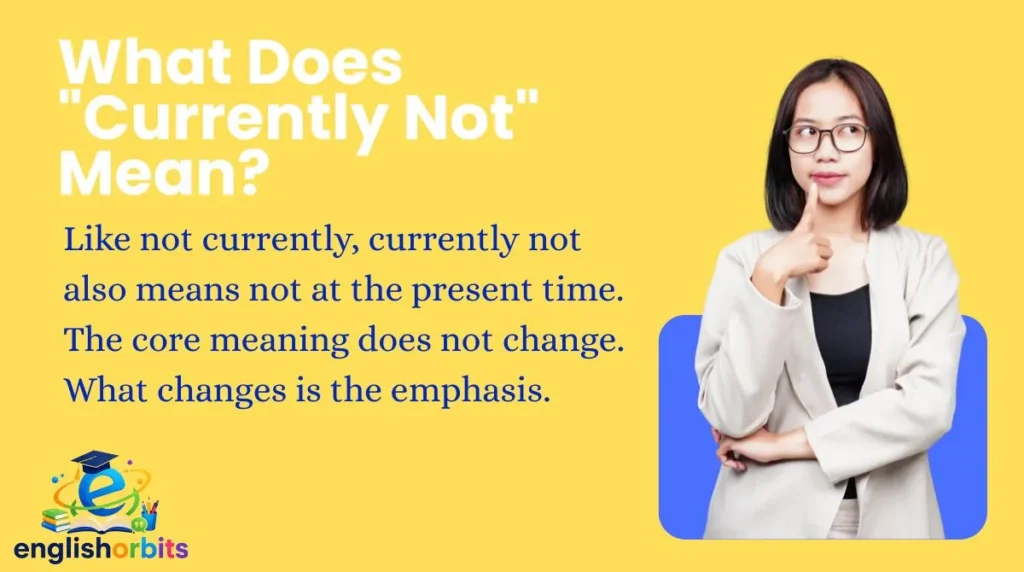
Like not currently, currently not also means not at the present time. The core meaning does not change. What changes is the emphasis.
When you place currently before not, you subtly draw attention to the time element. It suggests that the situation is true for now, but it may change in the future.
For example:
- We are currently not accepting new applications.
- The service is currently not available in your region.
Both sentences are grammatically correct. However, many native speakers would naturally say:
- We are not currently accepting new applications.
- The service is not currently available in your region.
That slight difference in word order makes not currently sound smoother in everyday English.
When Is “Currently Not” Appropriate?
Although it is less common, currently not has its place. Writers sometimes choose it when they want to emphasize the present moment or create a more formal tone.
You may see it in:
- Government announcements
- Technical documentation
- Legal writing
- Official notices
- Software status updates
For example:
- This feature is currently not supported on mobile devices.
- International shipping is currently not available.
- The portal is currently not accepting submissions.
These examples are perfectly acceptable, even though many editors would still prefer not currently for readability.
Origin and Usage of “Currently Not”
The phrase currently not developed naturally from English sentence structure rather than as a fixed expression.
Because English allows adverbs to appear in different positions, speakers sometimes place currently before not to emphasize the timing rather than the negative action.
Compare these sentences:
- We are not currently offering discounts.
- We are currently not offering discounts.
The first sounds more conversational.
The second places more focus on currently, almost implying:
“At this moment—not necessarily forever—we aren’t offering discounts.”
Pronunciation of “Currently Not”
In speech, currently not usually places stronger stress on currently.
For example:
We are CURRENTLY not accepting applications.
The speaker highlights the present time, often to imply that circumstances could change later.
Professional Use of “Currently Not”
Professional writers sometimes use currently not when they want to stress temporary conditions.
Examples:
- The application is currently not available.
- The software is currently not compatible with older devices.
- Our office is currently not open to visitors.
- The database is currently not responding.
While these are correct, many style editors would revise them to:
- The application is not currently available.
- The software is not currently compatible.
The revised versions typically sound more natural.
Academic Use of “Currently Not”
Academic writing occasionally uses currently not, especially when emphasizing the present state of research.
Examples:
- This hypothesis is currently not supported by empirical evidence.
- The treatment is currently not recommended.
- The findings are currently not conclusive.
- The data are currently not publicly accessible.
Again, these are grammatically correct, though many journals favor not currently because it reads more smoothly.
Everyday Examples of “Currently Not”
Although less frequent, you’ll still hear or read sentences like these:
- I’m currently not looking for a new apartment.
- She’s currently not available.
- We’re currently not traveling.
- He’s currently not using social media.
- They’re currently not accepting visitors.
- I’m currently not interested in changing jobs.
- The restaurant is currently not taking reservations.
- My phone is currently not working.
- The app is currently not responding.
- We’re currently not making any changes.
All of these are acceptable, but replacing currently not with not currently would usually make them sound more natural.
Key Differences Between “Not Currently” and “Currently Not”
Although the meaning is almost identical, the phrases differ in style and emphasis.
- Both are grammatically correct.
- Both mean “not at the present time.”
- Not currently is far more common in modern English.
- Currently not places extra emphasis on the time element.
- Not currently sounds smoother in conversation.
- Currently not appears more often in formal or technical writing.
- Neither phrase changes the factual meaning of the sentence.
- The difference is primarily one of word order and emphasis, not grammar.
At a Glance
Choose not currently if you want your writing to sound:
- Natural
- Conversational
- Professional
- Fluent
- Idiomatic
Choose currently not only when you intentionally want to stress the present situation or match the tone of formal documentation.
Grammar Explanation
Understanding why both phrases are correct becomes easier when you know how English adverbs work.
Part of Speech
- Currently is an adverb.
- Not is a negative particle.
The adverb modifies the verb phrase by indicating when something happens—or, in this case, does not happen.
Sentence Position
English adverbs often have flexible placement.
For example:
- She is currently working.
- She currently is working. (Less common but grammatical.)
Similarly:
- She is not currently working.
- She is currently not working.
Both follow accepted English grammar.
Which Position Sounds More Natural?
Modern English generally prefers:
Verb + not + adverb
Examples:
- is not currently
- are not currently
- was not currently
- have not currently (rare because “currently” doesn’t fit naturally with some perfect forms)
This explains why not currently appears much more often in everyday communication.
Formal vs. Informal Usage
| Style | Preferred Choice |
|---|---|
| Casual conversation | Not currently |
| Professional emails | Not currently |
| Business writing | Not currently |
| Academic papers | Usually not currently |
| Technical manuals | Either |
| Government documents | Either |
| Legal writing | Either, depending on emphasis |
Does the Meaning Ever Change?
Usually, no.
However, context can make the emphasis slightly different.
Consider these examples:
Not currently
We are not currently hiring.
The sentence simply states today’s situation.
Currently not
We are currently not hiring.
The speaker subtly highlights currently, hinting that hiring may resume later.
The factual meaning remains the same, but the second version places more attention on time.
Which Phrase Do Native Speakers Prefer?
In modern English, native speakers overwhelmingly favor not currently.
You’ll hear it in:
- Everyday conversations
- Television interviews
- Podcasts
- Newspapers
- Company websites
- Customer support responses
- Professional emails
- Job postings
Because it follows the rhythm that English speakers naturally expect, it tends to sound more fluent and less marked.
Real-Life Examples of Not Currently and Currently Not
The best way to understand these phrases is to see them in context. Below are original examples from everyday life, work, school, business, social media, and professional communication.
Everyday Conversation
- I’m not currently watching any new TV series.
- She’s not currently at home, but she’ll be back this evening.
- We’re not currently planning a move.
- He’s currently not interested in buying a new car.
- My sister is currently not using her laptop.
Workplace
- We are not currently hiring additional staff.
- The marketing team is not currently accepting new projects.
- Our office is currently not open to walk-in visitors.
- The position is not currently available.
- The software is currently not compatible with older operating systems.
Professional Emails
- We are not currently able to process your request.
- Unfortunately, this service is not currently offered in your area.
- The requested document is currently not available for download.
School and University
- The course is not currently part of the curriculum.
- Our professor is currently not accepting late assignments.
- The library is not currently open on Sundays.
Social Media
- I’m not currently posting on Instagram very often.
- The creator is currently not uploading new videos.
- We are not currently running any giveaways.
Text Messages
- Sorry, I’m not currently free to talk.
- I’m currently not near my phone.
- We’re not currently in town.
Customer Support
- This feature is not currently supported.
- International shipping is currently not available.
- Your account is not currently active.
These examples show that both phrases are correct, but not currently appears more naturally in most everyday situations.
Common Mistakes
Although both expressions are grammatically correct, writers sometimes use them awkwardly or unnecessarily. Here are some common mistakes to avoid.
| Incorrect | Why It’s a Problem | Better Version |
|---|---|---|
| We currently not accept applications. | Missing helping verb. | We are currently not accepting applications. |
| We not currently accept applications. | Incorrect word order. | We are not currently accepting applications. |
| I’m currently no working. | Incorrect negative form. | I’m currently not working. |
| She currently isn’t available now. | Redundant use of currently and now. | She isn’t currently available. |
| The shop isn’t currently open right now. | Repeats the same time idea twice. | The shop isn’t currently open. |
Tips to Avoid Errors
- Include the correct helping verb (is, are, was, were, has, etc.).
- Don’t combine currently with another time expression like right now unless you need extra emphasis.
- Choose one word order and keep your sentence natural.
- In general writing, prefer not currently.
Memory Tricks
Here are a few simple ways to remember which phrase to use.
Trick 1: Think About Everyday Speech
Ask yourself:
“How would I naturally say this in conversation?”
Most native speakers instinctively say:
I’m not currently available.
That makes not currently the safest choice.
Trick 2: Remember the Rhythm
English usually flows like this:
Verb + not + adverb
Examples:
- is not currently
- are not currently
- was not currently
This pattern sounds familiar because it’s the one you’ll encounter most often.
Trick 3: Use the Emphasis Test
If you’re simply stating a fact:
✅ Not currently
If you intentionally want to emphasize the present moment:
✅ Currently not
Frequently Asked Questions
Is not currently grammatically correct?
Yes. It is grammatically correct and is the most common and natural choice in modern English.
Is currently not wrong?
No. It is also grammatically correct. It is simply less common and often used for emphasis or in formal writing.
Which phrase sounds more natural?
Not currently sounds more natural in everyday conversation, business communication, and most forms of writing.
Do not currently and currently not mean the same thing?
Yes. In almost every situation, they mean “not at the present time.” The difference lies in emphasis rather than meaning.
Which phrase should I use in professional emails?
Use not currently unless you have a specific reason to emphasize the timing. It is the preferred choice for clear, natural business communication.
Is there a difference in American and British English?
No significant difference exists. Both American and British English use not currently more frequently than currently not.
Can I use these phrases in academic writing?
Yes. Both are acceptable, but not currently is generally preferred because it reads more smoothly and aligns with common editorial style.
Why do people confuse these phrases?
The confusion comes from the flexibility of English adverb placement. Since both word orders are grammatically possible, many writers wonder whether one is incorrect. In reality, the choice is mainly about naturalness and emphasis.
Final Verdict
Choosing between not currently and currently not is less about grammar and more about style.
Both expressions are correct, and both communicate the idea of “not at the present time.” However, they are not equally common.
For most situations—including conversations, professional emails, academic writing, customer support messages, websites, and business communication—not currently is the better choice.
It follows the natural rhythm of English, sounds more fluent, and is the wording that native speakers use most often.
Use currently not when you deliberately want to emphasize the present moment or when you’re writing in a formal, technical, or official context where that emphasis feels appropriate.
Quick Summary
- ✅ Not currently — Grammatically correct, natural, and the preferred choice in most contexts.
- ✅ Currently not — Grammatically correct but less common, often used for emphasis.
- ⭐ Recommendation: If you’re unsure, choose not currently. It will sound natural to both American and British English speakers and fit almost every writing situation.

Ghulam Qamar is an English grammar writer and language enthusiast dedicated to simplifying complex grammar concepts. He creates clear, practical, and beginner-friendly content that helps learners improve their English writing, speaking, and communication skills.