Have you ever heard someone call a statement a bald-faced lie, while someone else insists it should be bold-faced lie? You may also come across the phrase barefaced lie, especially in British English.
Since all three expressions sound similar, it’s easy to wonder whether they mean the same thing—or if one is simply incorrect.
The confusion is understandable. These phrases have evolved over centuries, and pronunciation has blurred the lines between them.
Today, all three appear in books, newspapers, online articles, and everyday conversation, but they aren’t always used in the same way or accepted by every editor.
Knowing which version to choose matters because language changes depending on your audience, writing style, and region.
Whether you’re writing an academic paper, a business email, a news article, or simply trying to improve your English, understanding the difference will help you sound more accurate and confident.
In this guide, you’ll learn where each expression came from, which one is considered standard, how American and British English differ, and when each phrase is the best choice.
Quick Answer
Bald-faced lie is the traditional and most widely accepted expression in American English.
Barefaced lie is the traditional form in British English.
Bold-faced lie has become increasingly common because many speakers reinterpret the phrase as referring to someone making a lie boldly. While many dictionaries recognize it as an accepted variant, many editors and style guides still prefer bald-faced lie or barefaced lie, depending on the variety of English.
In short:
- American English: bald-faced lie is usually preferred.
- British English: barefaced lie is usually preferred.
- Bold-faced lie: Common and increasingly accepted, but still viewed by some editors as a later variation rather than the original form.
Bald-Faced Lie, Bold-Faced Lie, or Barefaced Lie: Comparison Table
| Feature | Bald-Faced Lie | Bold-Faced Lie | Barefaced Lie |
|---|---|---|---|
| Meaning | A completely obvious or shameless lie | Usually means the same today | A completely obvious or shameless lie |
| Traditional? | Yes | No (later variation) | Yes |
| Modern Usage | Very common | Increasingly common | Very common in the UK |
| American English | Preferred | Widely understood | Less common |
| British English | Less common | Understood | Preferred |
| Formal Writing | Recommended | Sometimes avoided by editors | Recommended in British English |
| Academic Writing | Acceptable | Less preferred | Acceptable in British English |
| Everyday Conversation | Very common | Very common | Common in the UK |
| Dictionary Recognition | Yes | Yes, often as a variant | Yes |
| Meaning Difference | None today | None today | None today |
| Tone | Neutral to informal | Neutral to informal | Neutral to informal |
| Best Choice | American audiences | Casual conversation | British audiences |
What Does “Bald-Faced Lie” Mean?
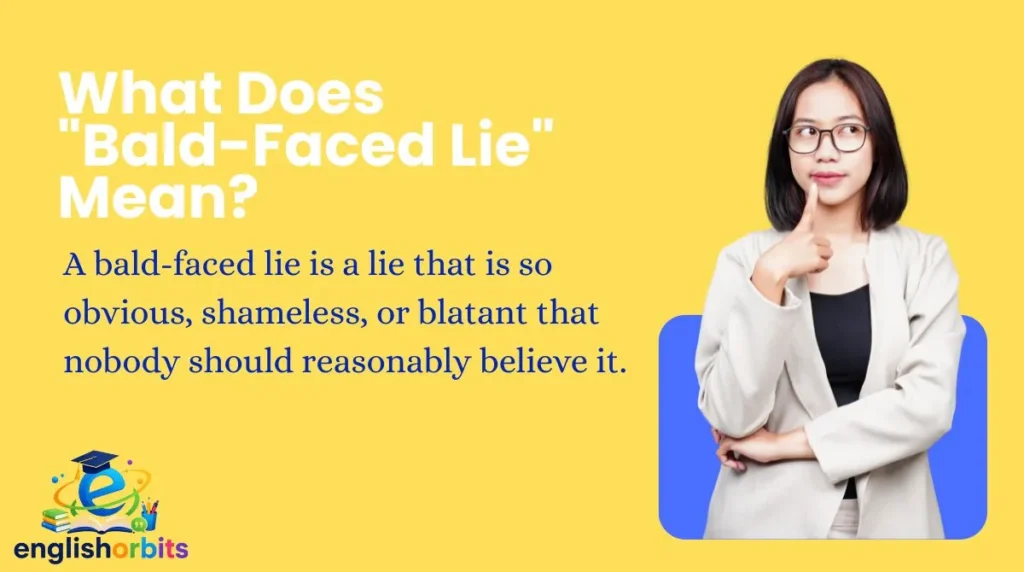
A bald-faced lie is a lie that is so obvious, shameless, or blatant that nobody should reasonably believe it. The speaker isn’t trying to hide the dishonesty. Instead, the lie is delivered openly, even when the truth is clear.
The phrase doesn’t describe someone’s appearance. Instead, bald-faced has historically carried the idea of being uncovered, exposed, or lacking disguise. In other words, the lie has no attempt at concealment.
Definition
A bald-faced lie is:
- an obvious lie
- a shameless falsehood
- a blatant untruth
- a statement made with complete disregard for the truth
Pronunciation
bald-faced lie
/BAWLD fayst lye/
Part of Speech
The phrase functions as a noun phrase.
- bald-faced = adjective
- lie = noun
Common Contexts
People use bald-faced lie in many situations, including:
- political debates
- journalism
- legal discussions
- workplace conversations
- family arguments
- everyday speech
Example Sentences
- That was a bald-faced lie, and everyone in the meeting knew it.
- Calling the report accurate was a bald-faced lie.
- She denied sending the email, but it was a bald-faced lie.
- The advertisement made several bald-faced lies about the product.
- His excuse sounded more like a bald-faced lie than a misunderstanding.
Where Did “Bald-Faced Lie” Come From?
Many people assume the phrase refers to someone being physically bald, but that’s not its original meaning.
Historically, bald could describe something that was plain, uncovered, or lacking ornament. Earlier forms of English also used bald-faced to describe something exposed or without disguise.
Over time, speakers applied this idea to lies. A bald-faced lie became a lie that wasn’t even disguised. It was completely exposed, obvious, and shameless.
Although the exact historical path is debated by language scholars, the expression has been documented for well over a century and became deeply established in American English.
Today, it remains the preferred traditional wording in the United States.
What Does “Bold-Faced Lie” Mean?
A bold-faced lie means exactly the same thing in modern English: an obvious or shameless lie.
However, its history is different.
Many linguists believe bold-faced lie developed because speakers naturally associated the phrase with someone telling a lie boldly or with great confidence. Since the pronunciation of bald-faced and bold-faced is very similar in many accents, people gradually began replacing one with the other.
This process is known in linguistics as folk etymology, where familiar words replace older expressions because they seem to make better sense.
Definition
A bold-faced lie is:
- a blatant lie
- a confident falsehood
- a shameless deception
Pronunciation
bold-faced lie
/BOHLD fayst lye/
Part of Speech
Like the traditional version:
- bold-faced = adjective
- lie = noun
Everyday Usage
Today, many native English speakers use bold-faced lie without realizing it developed later than bald-faced lie.
It appears frequently in:
- television interviews
- podcasts
- social media
- newspapers
- blogs
- casual conversation
Many modern dictionaries now include bold-faced lie because of its widespread use.
Even so, professional editors often recommend sticking with bald-faced lie when writing for an American audience.
Example Sentences
- He told a bold-faced lie during the interview.
- That claim was nothing but a bold-faced lie.
- Everyone recognized it as a bold-faced lie.
- She repeated the bold-faced lie despite the evidence.
- The article accused the company of spreading bold-faced lies.
What Does “Barefaced Lie” Mean?
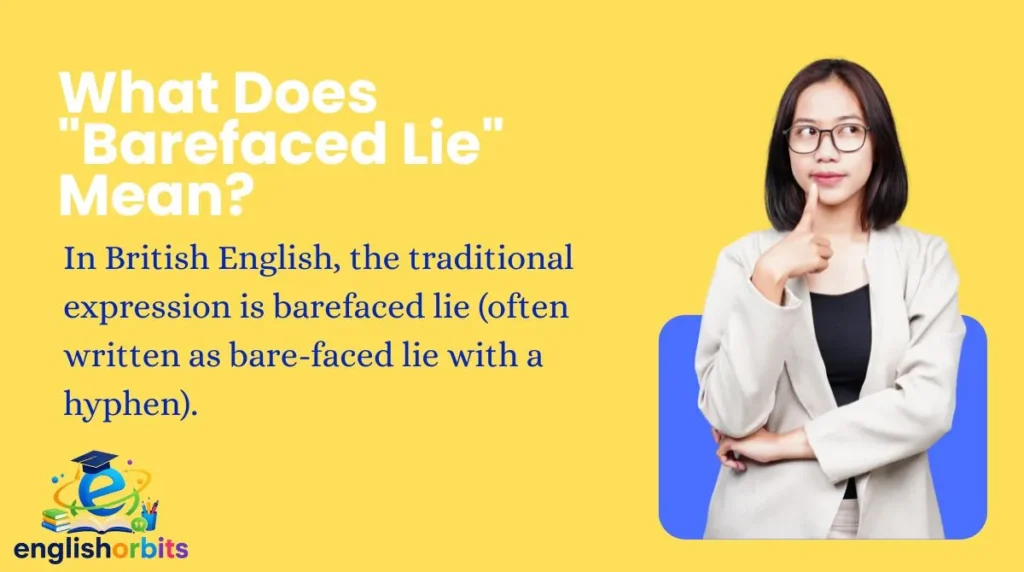
In British English, the traditional expression is barefaced lie (often written as bare-faced lie with a hyphen).
Here, barefaced means uncovered, open, or without concealment. Just like bald-faced lie, it emphasizes that the falsehood is completely obvious and shameless.
Although American readers understand barefaced lie, it sounds distinctly British to many of them.
Definition
A barefaced lie is:
- an undisguised lie
- an obvious falsehood
- a shameless deception
Pronunciation
barefaced lie
/BAIR fayst lye/
Common Usage
You’ll often find barefaced lie in:
- British newspapers
- UK legal writing
- British novels
- Commonwealth English
- everyday conversations in the UK
Example Sentences
- That was a barefaced lie from beginning to end.
- The witness told a barefaced lie in court.
- It would be a barefaced lie to deny the evidence.
- The newspaper described the statement as a barefaced lie.
- Everyone agreed it was a barefaced lie.
Why Are These Phrases So Easy to Confuse?
The confusion comes from several factors working together.
They Sound Similar
In many English accents, bald, bold, and sometimes even bare are pronounced similarly enough that listeners don’t immediately notice the difference.
They Share the Same Meaning
Today, all three expressions communicate the same basic idea: a lie that is obvious and shameless.
Language Changes Naturally
English constantly evolves. When speakers hear a phrase that seems unusual, they often replace unfamiliar words with more familiar ones.
Because bold-faced feels logical—someone telling a lie boldly—it spread naturally through speech and writing.
Different English Varieties Prefer Different Forms
American and British English have preserved different historical expressions.
As a result, readers may believe one version is wrong simply because they are more familiar with another.
Key Takeaways So Far
Bald-faced lie is the traditional American expression.
Barefaced lie is the traditional British expression.
Bold-faced lie is a modern variant that has become increasingly common because it sounds logical and resembles the original phrase.
All three now communicate essentially the same meaning, but your choice should depend on your audience and the level of formality.
Grammar Explanation
Although bald-faced lie, bold-faced lie, and barefaced lie are fixed expressions (idioms), understanding their grammar helps you use them correctly in both speech and writing.
Parts of Speech
In all three expressions:
- Bald-faced / Bold-faced / Barefaced = compound adjective
- Lie = noun
Together, they form a noun phrase.
Examples
- That was a bald-faced lie.
- She told a bold-faced lie.
- It was a barefaced lie.
Notice that the adjective always comes before the noun lie.
Can You Use Them as Adjectives?
Yes. These expressions can also describe something directly.
Examples
- His statement was bald-faced.
- The accusation seemed barefaced.
- The deception was bold-faced.
However, they are far more common in the full expression bald-faced lie, bold-faced lie, or barefaced lie.
Hyphenation Rules
Hyphenation depends on where the adjective appears in the sentence.
Before a Noun
Use a hyphen.
✔ bald-faced lie
✔ bold-faced lie
✔ bare-faced lie
Examples
- It was a bald-faced lie.
- She made a bare-faced accusation.
- They spread a bold-faced rumor.
After the Noun
Many modern publishers drop the hyphen.
Examples
- The lie was bald faced.
- The statement was barefaced.
- His excuse sounded bold faced.
However, many style guides still keep the hyphen for consistency.
Capitalization
These expressions are common nouns.
Do not capitalize them unless they begin a sentence.
✔ That was a bald-faced lie.
✔ She called it a barefaced lie.
✘ That Was A Bald-Faced Lie.
Plural Form
Only lie changes.
✔ bald-faced lies
✔ bold-faced lies
✔ barefaced lies
Examples:
- The report contained several bald-faced lies.
- The article exposed multiple barefaced lies.
Formal vs Informal Usage
| Context | Best Choice |
|---|---|
| Academic paper | bald-faced lie (US), barefaced lie (UK) |
| Business writing | bald-faced lie if quotation or necessary |
| Journalism | bald-faced or barefaced depending on publication style |
| Conversation | Any version understood by your audience |
| Social media | All three are common |
Although these expressions appear in formal writing, editors often avoid them because they carry strong emotional meaning.
Sometimes a more neutral phrase works better.
Examples include:
- false statement
- inaccurate claim
- misleading assertion
- demonstrably false statement
Which Form Do Major Style Guides Prefer?
Professional editors usually follow consistency rather than personal preference.
AP Style
For American publications, bald-faced lie is generally preferred because it is the traditional American form.
Chicago Manual of Style
Chicago doesn’t specifically rule on the expression, but editors following Chicago typically use the established form found in reputable dictionaries.
For American audiences, that usually means bald-faced lie.
British Publishers
British editors usually choose barefaced lie because it matches long-standing British usage.
Dictionary Usage
Most major dictionaries now recognize all three forms to varying degrees.
Here’s the general pattern.
| Dictionary | Bald-Faced | Bold-Faced | Barefaced |
|---|---|---|---|
| American dictionaries | Preferred | Listed as variant | Recognized |
| British dictionaries | Recognized | Recognized | Preferred |
This reflects modern usage rather than strict correctness.
Which One Should You Use?
If you’re unsure, follow this simple rule.
Writing for an American Audience
Choose:
bald-faced lie
This is the safest and most widely accepted option.
Writing for a British Audience
Choose:
barefaced lie
It sounds more natural to British readers.
Casual Conversation
If you say bold-faced lie, most native English speakers will understand exactly what you mean.
Very few people will notice the difference.
Professional Writing
Professional communication usually benefits from precise language.
Instead of writing:
“The CEO told a bald-faced lie.”
You might write:
“The CEO made a statement that was demonstrably false.”
However, if you’re quoting someone or writing an opinion piece, the idiom may fit naturally.
Examples:
- Several witnesses described the claim as a bald-faced lie.
- Critics called the statement a barefaced lie.
Academic Writing
Academic English generally favors objective wording.
Instead of:
“It was a bold-faced lie.”
Write:
- The statement was unsupported by evidence.
- The claim was factually incorrect.
- The assertion contradicted available data.
The idiom is acceptable when discussing rhetoric or quoting someone directly.
Everyday Conversation
These expressions are especially common in spoken English.
Examples include:
- That’s a bald-faced lie.
- Don’t tell me a bold-faced lie.
- Everyone knows that’s a barefaced lie.
Because they are idioms, native speakers rarely stop to think about their literal meanings.
Real-Life Examples
Below are original examples showing how these expressions appear in different situations.
Everyday Conversation
- That’s a bald-faced lie, and you know it.
- Nobody believed his bold-faced lie for even a second.
- She laughed because it was such a barefaced lie.
Family
- Mom immediately recognized it as a bald-faced lie.
- My brother told the most obvious bold-faced lie imaginable.
School
- The teacher knew the missing homework excuse was a bald-faced lie.
- Claiming your dog ate a digital assignment sounds like a barefaced lie.
Workplace
- The manager called the explanation a bald-faced lie.
- Nobody in the meeting accepted the bold-faced lie.
- The audit exposed several barefaced lies in the report.
Business
- Investors accused the company of making bald-faced lies about profits.
- The advertisement contained what critics called barefaced lies.
Journalism
- The newspaper described the statement as a bald-faced lie.
- Several commentators referred to it as a bold-faced lie.
Social Media
- Thousands of users labeled the post a bald-faced lie.
- The comments section exploded after the bold-faced lie went viral.
Text Messages
- Stop texting me bald-faced lies.
- That’s the biggest bold-faced lie I’ve heard today.
Academic Discussion
- The historian argued the accusation was a barefaced lie.
Legal Context
- The attorney avoided calling it a bald-faced lie, choosing more neutral language instead.
Politics
- Opponents described the campaign promise as a bald-faced lie.
- Supporters denied it was a barefaced lie.
Daily Speaking
- Everyone in the room knew it was a bold-faced lie.
- I can’t believe he expected us to accept that bald-faced lie.
Common Mistakes
Mistake 1: Thinking Only One Version Exists
❌ Only bald-faced lie is correct.
✔ Better:
Both bald-faced lie and barefaced lie are traditional expressions, while bold-faced lie is a widely recognized modern variant.
Mistake 2: Using the Wrong Version for Your Audience
An American newspaper usually prefers:
✔ bald-faced lie
A British newspaper usually prefers:
✔ barefaced lie
Choosing the version your audience expects improves readability.
Mistake 3: Assuming “Bold-Faced” Is Always Wrong
Some people still call it an error.
Modern dictionaries, however, recognize bold-faced lie because of its widespread use.
It isn’t simply a typo—it has become an accepted variant in modern English.
Mistake 4: Forgetting the Hyphen
Before a noun, use a hyphen.
✔ bald-faced lie
✔ bare-faced lie
✘ bald faced lie (in formal edited writing)
Mistake 5: Using the Idiom in Neutral Reports
Instead of writing:
❌ The witness told a bald-faced lie.
A factual report might say:
✔ The witness made a false statement.
✔ The witness’s testimony conflicted with the evidence.
This keeps the tone objective.
Quick Summary
Bald-faced lie is the traditional American expression and the safest choice for U.S. readers.
Barefaced lie is the traditional British equivalent.
Bold-faced lie has become common through everyday usage and is widely understood, although some editors still prefer the older traditional forms.
Memory Tricks
If you struggle to remember which phrase to use, these simple tricks can help.
Trick 1: Think About Your Audience
This is the easiest rule to remember.
- American readers → bald-faced lie
- British readers → barefaced lie
If you’re writing for an international audience, bald-faced lie is usually the safest choice because it’s widely recognized.
Trick 2: Remember the History
Think of bald as meaning uncovered or without disguise.
A bald-faced lie is a lie that makes no attempt to hide the truth. It’s completely exposed.
Trick 3: “Bold” Came Later
Imagine someone telling a lie boldly and confidently.
That mental image explains why many people naturally say bold-faced lie, even though it developed later than the traditional phrase.
Trick 4: “Bare” Means Uncovered
In British English, barefaced means open, uncovered, or without concealment.
A barefaced lie is therefore a lie with nothing hiding it.
Quick Memory Chart
| If you want… | Use… |
|---|---|
| Standard American English | bald-faced lie |
| Standard British English | barefaced lie |
| Casual modern conversation | bold-faced lie is widely understood |
Common Alternatives
Sometimes an idiom isn’t the best choice. If you’re writing formally or want a less emotional tone, consider these alternatives:
- blatant lie
- outright lie
- obvious lie
- shameless lie
- false statement
- inaccurate claim
- misleading statement
- fabricated claim
- untrue assertion
- deliberate falsehood
Each alternative has a slightly different tone, so choose one that matches your audience and purpose.
People Also Ask (FAQs)
Is bald-faced lie or bold-faced lie correct?
Both are used in modern English. However, bald-faced lie is the traditional and generally preferred form in American English, while bold-faced lie is a later variant that many dictionaries now recognize because of its widespread use.
Is barefaced lie the same as bald-faced lie?
Yes. They have the same meaning: an obvious or shameless lie. The main difference is regional usage. Barefaced lie is more common in British English, while bald-faced lie is more common in American English.
Why do people say bold-faced lie?
Many speakers associate the phrase with someone telling a lie boldly or confidently. Because bald-faced and bold-faced sound similar in many accents, the newer form became popular through everyday speech.
Which version should I use in formal writing?
Use the version that matches your audience:
- bald-faced lie for most American publications.
- barefaced lie for British publications.
If you’re writing an objective report or academic paper, consider replacing the idiom with a more neutral phrase such as false statement or factually incorrect claim.
Is bold-faced lie considered wrong?
Not exactly. Some editors still discourage it because it is not the original expression. However, many modern dictionaries recognize it as an accepted variant due to its frequent use in contemporary English.
Do all three phrases mean the same thing?
Yes. In modern English, bald-faced lie, bold-faced lie, and barefaced lie all describe an obvious, shameless, or blatant lie. The primary difference lies in history, editorial preference, and regional usage—not meaning.
Which phrase is more common in the United States?
Bald-faced lie remains the preferred traditional expression in American English, although bold-faced lie is also common in everyday conversation and online writing.
Can I use these expressions in business emails?
You can, but use caution. These idioms are strong and may sound confrontational. In professional communication, phrases like incorrect statement, unsupported claim, or factually inaccurate information are often more appropriate.
Related Terms You May Also Encounter
As you explore English idioms and usage, you may come across similar expressions, including:
- white lie
- outright lie
- half-truth
- stretch the truth
- tell a fib
- false accusation
- misleading statement
- fabrication
- deception
- misinformation
Understanding these related terms helps you choose the most accurate expression for different contexts.
Quick Summary Box
Meaning: All three expressions refer to an obvious or shameless lie.
American English: bald-faced lie is the traditional and preferred form.
British English: barefaced lie is the traditional and preferred form.
Modern Variant: bold-faced lie is widely understood and increasingly accepted, though some editors still favor the older forms.
Best Practice: Match the expression to your audience and writing style.
Final Verdict
If you’re looking for a single “correct” answer, the truth is more nuanced than many people expect.
- Bald-faced lie is the traditional and preferred choice in American English.
- Barefaced lie is the traditional and preferred choice in British English.
- Bold-faced lie has become an established modern variant because it sounds logical to many speakers and appears frequently in contemporary speech and writing.
For most professional and edited American writing, bald-faced lie remains the safest option. If you’re writing for a British audience, barefaced lie will sound more natural. In casual conversation, you’ll hear all three, and most native speakers will understand them without confusion.
The key takeaway is that these expressions share the same meaning. Choosing the right one is less about correctness and more about audience, regional preference, and editorial style.
Conclusion
The debate over bald-faced lie, bold-faced lie, or barefaced lie is a great example of how English evolves over time.
While the traditional forms differ between American and British English, everyday usage has allowed bold-faced lie to gain widespread acceptance as a modern variant.
Instead of asking which phrase is universally “right,” it’s more helpful to ask which one is most appropriate for your readers.
If you’re writing for an American audience, bald-faced lie is usually the best choice. For British readers, barefaced lie fits naturally. And if you’re speaking informally, bold-faced lie is unlikely to raise eyebrows.
Understanding these subtle differences not only improves your vocabulary but also makes your writing more precise, polished, and audience-aware.
By choosing the expression that best matches your context, you’ll communicate with greater confidence and clarity.

Ghulam Qamar is an English grammar writer and language enthusiast dedicated to simplifying complex grammar concepts. He creates clear, practical, and beginner-friendly content that helps learners improve their English writing, speaking, and communication skills.